Ninebot Segway ES3 Electric Scooter Review: Discontinued in 2021, Still a First Scooter Argument
The Ninebot Segway ES3 was discontinued in 2021 but is still traded heavily used, and it remains a genuine argument as a first electric scooter.
Ninebot Segway ES3 Review: Discontinued in 2021, Still a First Scooter Argument
The Ninebot Segway ES3 was discontinued in 2020, yet in 2025 it remains one of the most traded used electric scooters on the second-hand market. If you are shopping on a budget for your first scooter, you will encounter it. Buy one only after you inspect the stem, the mudguard, and the battery. The successor F-series and the Max G30 fixed almost everything that wears out on the ES3, but they cost more. The ES3’s argument is price, not performance.
Who the ES3 Suits and Who Should Skip it
Buy this scooter if you fit one of three profiles. First, the urban commuter covering a last-mile gap of 3 to 8 km each way, who folds the machine twice daily and carries it onto a train. At 14 kg with the external pack, the ES3 is genuinely portable, lighter than the Ninebot Max G30 by nearly 5 kg. Second, the multi-modal rider who needs folded dimensions of 113 x 43 x 40 cm to fit under an office desk or a train seat. Third, the parent buying for a teenager who needs a capped-speed machine with a known failure record, not a mystery scooter from a generic brand.
Skip the ES3 if you want an e-bike or e-moped. Skip it if you expect a weatherproof car replacement: the IP54 rating covers the pack housing only, not the cockpit electronics, and the throttle and display fail in sustained rain. If your budget reaches the band where hydraulic brakes and pneumatic tyres appear, spend more and buy something built to last. The ES3 was built to the budget of 2018.
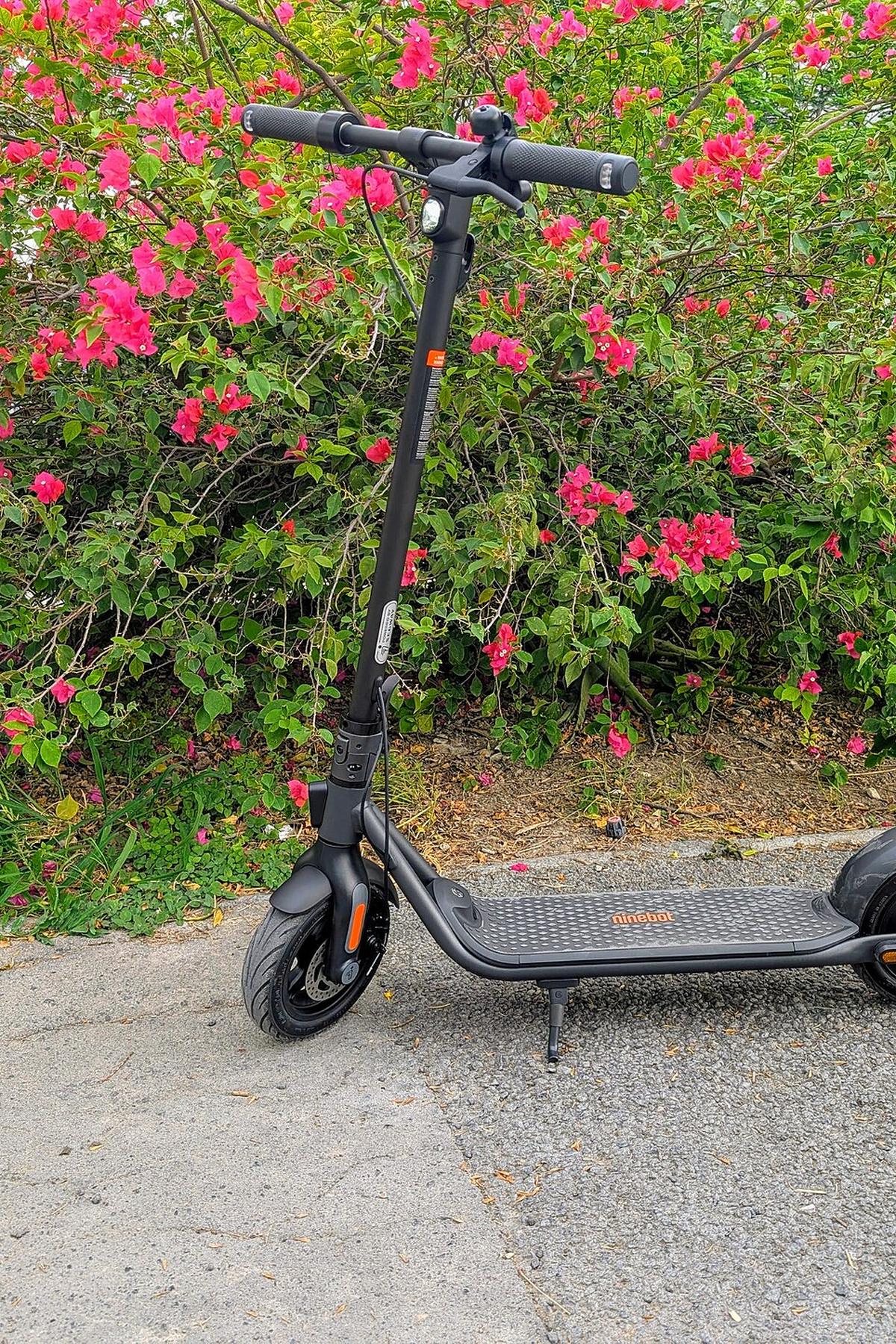

The Defining Ride Characteristic: Solid Tyres
The ES3 uses an 8-inch solid rubber front tyre and a 7.5-inch solid rubber rear tyre. There are no pneumatic tubes, no inflation checks, and no pinch flats. That is the only advantage. Every road vibration transmits directly through the solid tyres into the stem, the deck, and the electronics. The DURABLE dossier on solid tyres is specific: they accelerate solder-joint fatigue on the control board and stem-clamp wear. Owners report that the ride on anything but smooth tarmac is harsh enough to loosen bolts over time. The ES3 has a front spring shock absorber and no rear suspension, so the rear wheel is especially punishing. If your commute includes cobblestones, brick paving, or potholes, the ES3 will shake components loose faster than a scooter with pneumatic tyres.
| Specification | Value | Source |
|---|---|---|
| Top speed | 15 mph | Manufacturer |
| Range | 17 mi | Owner reported |
| Motor configuration | Single hub | Manufacturer |
| Motor (nominal) | 300 W | Manufacturer |
| Motor (peak) | 700 W | Manufacturer |
| Battery | 374 Wh | Manufacturer |
| Charge time | 6 h | Manufacturer |
| Hill grade | 10 % | Manufacturer |
| Weight | 14 kg | Manufacturer |
| Max rider weight | 100 kg | Manufacturer |
| Brakes | Electronic and mechanical rear | Manufacturer |
| Suspension | Front and rear shock | Manufacturer |
| Tyres | Solid, honeycomb | Manufacturer |
| Tyre size | 8 in | Manufacturer |
| Water resistance | IP54 | Manufacturer |
| Lighting | LED front, brake rear | Manufacturer |
| Display | Integrated LED | Manufacturer |
| Folded size | 113 x 43 x 40 cm | Manufacturer |
| Deck | 48 x 15 cm | Manufacturer |
| Warranty | 12 months | Manufacturer |
Real-World Range: What a Used Pack Delivers
The manufacturer marketed the ES3 with a range of 45 km under test conditions: a 75 kg rider, 25°C, 15 km/h constant speed on flat pavement. That is not the real-world figure. Halve the published range for an 85 kg rider at full speed. Owners report that a fresh ES3 pack delivers roughly 28 to 32 km for a rider of that weight. A used unit with degradation, the standard 300 to 400 cycles before capacity drops below 80%, will deliver 18 to 25 km. The total capacity is 374 Wh split between an internal 187 Wh pack and an external 187 Wh pack mounted on the stem. Both must be charged separately via their own barrel connectors, and the charge time for both is 6 hours. If you are buying used, ask the seller whether the external pack connector pins show corrosion. That is the most common external pack fault: the pins bend or corrode, causing intermittent power loss.
Voltage Sag and Hill Performance
When the charge drops below 80%, the 15 mph top speed drops to 12 or 13 mph. The 300 W nominal motor can pull 700 W peak, but only when the pack is above 80%. On a hill above 10% grade, the scooter will struggle with an 85 kg rider. The manufacturer claims 10% grade capability; owners report that the scooter slows to a crawl above 12% and the controller can overheat on sustained climbs.
Ninebot ES3 Discontinued: What Changes When a Scooter Leaves Production
Segway-Ninebot stopped manufacturing the ES3 in 2020. That means no new packs from the manufacturer, no new control boards, and no warranty support. The parts situation in 2026 is entirely third-party. Packs are discontinued by Segway; you must buy from AliExpress, eBay, or specialist scooter parts retailers. Control boards are available through the same channels. Solid tyres are available third-party because the size, 8 inch front, 7.5 inch rear, is shared with other models. The BMS (Battery Management System) inside the packs can lock out after a firmware update mismatch between the internal and external units. The procedure for resetting a BMS lockout on this specific pack is not documented by Segway; you will find instructions scattered across forums in multiple languages. If you are not comfortable opening a pack and bench-resetting the BMS, a used ES3 with a locked unit is a paperweight.
Ninebot ES3 Used Buying: What to Inspect Before Purchase
Buying a used ES3 requires a checklist. Walk through these points with the seller before you hand over cash.
Stem Folding Mechanism
This is the single highest-consequence mechanical joint on the scooter. The ES3 stem folding mechanism develops play and creaking over time. Grasp the handlebars and rock them side-to-side. If you feel lateral movement at the clamp, the mechanism is already worn. Failure at speed is catastrophic, the stem can fold forward under braking. The fix is tightening or replacing the clamp, but not all aftermarket clamps fit the ES3 geometry. Check for cracks in the cast aluminium around the folding joint.
Rear Mudguard Fracture
The rear mudguard, which also houses the mechanical foot brake, cracks at the mounting points. This is the canonical fault from the Xiaomi M365 and the ES3 shares the design flaw. If the mudguard is cracked, the brake becomes unreliable and the tail-light wiring can detach. Replacement mudguards are available third-party, but check whether the seller has already fitted a reinforced version.
Display Delamination
The LED dashboard delaminates from UV exposure and moisture. If the display cover is lifting, water has already entered the electronics behind it. The display is not separately replaceable from the control board on the ES3; you may need a new dashboard assembly.
Error Codes
Turn the scooter on and ride it. Error code 14 means throttle hall sensor fault. Error code 18 means hall sensor abnormality in the motor. Error code 42 means external pack communication failure. Any of these codes means the scooter needs a new part before it is rideable.
Battery History
Ask how the scooter was stored. Lithium-ion cells degrade fastest when stored at 100% charge in heat. If the seller left the scooter plugged in for months, the cycle life is probably below 300 cycles. The BMS will lock out if the cells are imbalanced, and the only fix is a bench reset or replacement.
Ninebot ES3 Solid Tyres: the Trade-Off Explained
The solid tyres are the defining ride characteristic of the ES3. No punctures, no pressure checks, no inner tubes. The trade-off is that solid tyres transmit every road vibration to the stem, deck, and electronics. The DURABLE dossier notes that this accelerates solder-joint fatigue and stem-clamp wear. On the ES3, the solid tyres also de-bond from the hub under heat and shear stress. If the solid tyre separates from the hub, the rider loses drive and reduced braking. This is rare but documented. The ride quality is the main reason the successor models, the Ninebot Max G30 and the F-series, switched to tubeless pneumatic and self-sealing tubeless tyres. If your primary roads are smooth asphalt, the solid tyres are an acceptable trade-off. If your route includes rough pavement, you will regret the ES3 within the first week.
Ninebot ES3 Successor: What the F-Series and Max G30 Fixed
The Segway Ninebot F-series and the Max G30 are the natural successors to the ES3. The F-series uses a 300 W nominal motor with mechanical disc brakes and tubeless tyres. The Max G30 uses self-sealing tubeless tyres, a 300 W nominal motor, and has a proven fleet pedigree, it is the scooter that rental operators chose for durability. Both models fixed the ES3's weaknesses: the stem clamp is stronger, the rear mudguard is reinforced, the display is sealed against moisture, and the pack BMS is firmware-compatible across internal and external units. The F-series and Max G30 cost more at the mid price band, but they deliver a real range of 28 to 40 km for an 85 kg rider, compared to the ES3's 18 to 25 km. If you can stretch your budget to a used F-series or a used Max G30, you avoid every fault that makes the ES3 a gamble.
Failure Modes the ES3 Owner Must Know
Beyond the stem wobble and mudguard crack, the ES3 has specific faults that a used buyer should budget for.
Control Board MOSFET Burnout
The control board uses MOSFETs that handle the motor current. Prolonged hill climbing at high ambient temperature causes the MOSFETs to overheat and burn out. The scooter cuts power without warning. Recovery requires a new control board, which costs roughly one-quarter of the scooter's used value.
BMS Lockout
The BMS locks out when the cells become imbalanced or after a deep discharge. The scooter refuses to charge or discharge. The fix requires opening the pack and bench-resetting the BMS, which is not a beginner procedure. If both packs lock out simultaneously, the scooter is worth only its parts value.
Charging Port Melt
The barrel connectors on the external pack can arc if the connector is loose. The port housing melts and can short the unit. Use only the original charger, never a third-party charger with a different voltage or current rating.
Brake Cable Stretch
The mechanical foot brake uses a cable routed through the folding mechanism. The cable frays internally and fails at the fold point. Replace the cable at the first sign of reduced braking force.
The Honest Verdict: First-Scooter Argument, Not a Performance Machine
The Ninebot Segway ES3 is not a scooter you buy for range, comfort, or reliability. You buy it because it is available used at a budget price, it weighs 14 kg, and it folds small enough to carry onto a bus. The solid tyres mean no punctures, but they transmit every vibration to the electronics. The range is 18 to 25 km for an 85 kg rider, enough for a short commute, not enough for a round trip if the pack is degraded. The stem clamp will develop play, the rear mudguard will crack, and the BMS can lock out. If you are a first-time buyer with a tight budget and a short, smooth commute, the ES3 can work. If you can afford the mid price band of the F-series or Max G30, skip the ES3. Discontinued is not deleted, but it is also not supported.
Full specification
| Top speed | 15 mph | manufacturer |
|---|---|---|
| Range | 17 mi | owner reported |
| Motor configuration | Single hub | manufacturer |
| Motor (nominal) | 300 W | manufacturer |
| Motor (peak) | 700 W | manufacturer |
| Battery | 374 Wh | manufacturer |
| Charge time | 6 h | manufacturer |
| Hill grade | 10 % | manufacturer |
| Weight | 14 kg | manufacturer |
| Max rider weight | 100 kg | manufacturer |
| Brakes | Electronic and mechanical rear | manufacturer |
| Suspension | Front and rear shock | manufacturer |
| Tyres | Solid, honeycomb | manufacturer |
| Tyre size | 8 in | manufacturer |
| Water resistance | IP54 | manufacturer |
| Lighting | LED front, brake rear | manufacturer |
| Display | Integrated LED | manufacturer |
| Folded size | 113 x 43 x 40 cm | manufacturer |
| Deck | 48 x 15 cm | manufacturer |
| Warranty | 12 months | manufacturer |
Figures labelled manufacturer are the maker's own claim and are measured by them. Owner reported figures are aggregated from owners and are the ones worth planning around.
Common Questions
Is the Ninebot Segway ES3 still worth buying in 2025?
Only if you find a used unit in good condition for a budget price, below roughly the band where the F-series and Max G30 sit, and only if you inspect the stem clamp, mudguard, display, and pack history before purchase. The scooter was discontinued in 2020 and parts availability is third-party only. It is a first-scooter argument at a budget price band, not a performance machine.
What is the real range of the Ninebot ES3 for an 85 kg rider?
A fresh pack delivers roughly 28 to 32 km. A used unit with 300 to 400 cycles, which is the typical lifespan before capacity drops below 80%, delivers 18 to 25 km. The manufacturer's claimed 45 km range assumes a 75 kg rider at 15 km/h on flat pavement.
Can I replace the solid tyres on the ES3 with pneumatic tyres?
No. The ES3 rims are designed for solid tyres. Pneumatic tyres require a different rim profile and inner tube. The 8-inch front and 7.5-inch rear solid tyres are available third-party.
How do I reset a BMS lockout on the ES3 battery?
The procedure is not documented by Segway. You must open the pack, disconnect the BMS board, measure each cell group voltage, balance them with a hobby charger, and reconnect. This requires electrical knowledge and equipment. If you are not comfortable, budget for a replacement pack from a third-party seller.
What is the main difference between the ES3 and the Ninebot Max G30?
The Max G30 uses self-sealing tubeless pneumatic tyres, a 300 W nominal motor, a reinforced stem clamp, and a sealed display. It weighs nearly 19 kg, 5 kg more than the ES3, but delivers 28 to 40 km real range and has a proven fleet durability record. The ES3 is lighter and cheaper used; the Max G30 is heavier and more reliable.
Read next
-
 How to Choose an Electric Scooter: Brakes, Range and Carry Weight First
How to choose an electric scooter by the specs that matter: real range for your weight, brake types for wet stopping, and carry weight for daily use.
How to Choose an Electric Scooter: Brakes, Range and Carry Weight First
How to choose an electric scooter by the specs that matter: real range for your weight, brake types for wet stopping, and carry weight for daily use.
-
 Electric Scooter Safety: NTA-8776 Helmets, Braking Distance and Visibility
Electric scooter safety starts with the NTA-8776 helmet standard, understanding real braking distances, and knowing the mechanical failure modes that matter at speed.
Electric Scooter Safety: NTA-8776 Helmets, Braking Distance and Visibility
Electric scooter safety starts with the NTA-8776 helmet standard, understanding real braking distances, and knowing the mechanical failure modes that matter at speed.
-
 Electric Scooter Batteries: Wh Capacity, 21700 Cells and Real Cycle Life
Electric scooter batteries explained: why watt-hours is the honest capacity unit, how 21700 cells differ from 18650, and what actually shortens pack life.
Electric Scooter Batteries: Wh Capacity, 21700 Cells and Real Cycle Life
Electric scooter batteries explained: why watt-hours is the honest capacity unit, how 21700 cells differ from 18650, and what actually shortens pack life.
-
 Electric Scooter Commuting: Carry Weight, Folded Size and Wet Weather Reality
What electric scooter commuting actually demands: real carry weight for stairs, folded dimensions for trains, wet weather survival and charging logistics.
Electric Scooter Commuting: Carry Weight, Folded Size and Wet Weather Reality
What electric scooter commuting actually demands: real carry weight for stairs, folded dimensions for trains, wet weather survival and charging logistics.
-
 Electric Scooter Maintenance: Stem Bolts, Brake Pads and Tyre Pressure Intervals
Electric scooter maintenance schedule covering stem bolt torque checks, brake pad intervals, tyre pressure and the folding mechanism service that prevents failure.
Electric Scooter Maintenance: Stem Bolts, Brake Pads and Tyre Pressure Intervals
Electric scooter maintenance schedule covering stem bolt torque checks, brake pad intervals, tyre pressure and the folding mechanism service that prevents failure.
-
 Fluid FreeRide CityRider
The Fluid Freeride CityRider is the mid-band commuter this catalogue keeps pointing people at when they arrive looking at something twice the weight.
Fluid FreeRide CityRider
The Fluid Freeride CityRider is the mid-band commuter this catalogue keeps pointing people at when they arrive looking at something twice the weight.
-
 Weped FS
The Weped FS weighs 45 kg and has real hydraulic suspension, and that weight is the organising fact of ownership no spec sheet can soften.
Weped FS
The Weped FS weighs 45 kg and has real hydraulic suspension, and that weight is the organising fact of ownership no spec sheet can soften.
-
 Rion RE90
The Rion RE90 is the lightest genuinely fast electric scooter, built in small numbers with almost no weather sealing and a six-month warranty.
Rion RE90
The Rion RE90 is the lightest genuinely fast electric scooter, built in small numbers with almost no weather sealing and a six-month warranty.
-
 Mercane MX60
The Mercane MX60 is a 41 kg dual-motor scooter whose real story is the gap between what it can do and what an owner will do with it daily.
Mercane MX60
The Mercane MX60 is a 41 kg dual-motor scooter whose real story is the gap between what it can do and what an owner will do with it daily.