How to Ride Your Electric Scooter in Traffic with Safe Road Position and Hand Signals
Electric Scooter Riding In Traffic Road Position: Where You Stand Decides Everything
Every electric scooter rider on urban roads faces the same question: which part of the lane keeps you safest? The answer is a deliberate choice between two positions, not a default. You ride centre-lane or you ride kerb-side. Centre-lane means you block unsafe overtakes and hold visibility at junctions. Kerb-side means you let faster traffic pass when the gap is safe. Pick the wrong one and you invite a close pass or a door strike.
Your standing stance changes the geometry of every interaction. Your head sits at car wing-mirror height, roughly 1.2 to 1.4 metres. That puts you in the driver's blind spot and in the door zone of parked cars. A car door opening into your path is a hazard cyclists face too, but the scooter rider's lack of time to react and the small tyre contact patch make the consequence worse. You do not have a seat to brace against. Your knees are your suspension. That changes how you brake, how you signal, and how you hold your line.
Primary Position: Centre Of The Lane At Junctions And On Narrow Roads
When you ride centre-lane, your wheels run along the left tyre track of a car (in left-hand drive countries). Use it when the lane is too narrow for a car to pass you safely within the same lane, any lane under 3.5 metres wide. Use it on approach to a junction, a roundabout, or a traffic light. Use it when you are filtering past stationary traffic and the moving lane opens up.
The reason is simple: a driver behind you cannot squeeze past. If you ride kerb-side on a narrow lane, a driver may attempt a close pass. The moment a car's wing mirror overlaps your handlebar, you lose control. Taking the centre forces the driver to change lane or wait. At a junction, centre-lane positioning prevents a left-hooking driver from cutting you off. You are visible where they have to look.
Door Zone: Your Head Height Is The Danger
Parked cars are the trap that most new scooter riders miss. Your standing height puts your head and shoulders exactly level with a driver's wing mirror and the top edge of a car door. A cyclist sits lower and the door arcs over their torso. You get the full impact. On any street with parked cars, ride at least 1.5 metres from the parked line. That means riding centre-lane if the door zone occupies the kerb-side position. Never ride in the zone where a door could open. If the lane is too narrow to avoid it, slow to walking pace and scan each parked car for movement inside.
Secondary Position: Kerb-Side For Overtaking And Wide Lanes
Kerb-side position puts you 50 to 100 cm from the kerb, within the left third of the lane. Use it on wide roads where a car can pass you while staying in its lane with a safe gap. Use it when you want to let a faster rider or car overtake you. Look back, shoulder-check, and move left if clear. Use it when you are filtering past slower traffic on the left, where the space between the kerb and the moving lane is just wide enough for a scooter.
Never stay kerb-side through a junction. The risk of a driver turning left across your path from the lane next to you is too high. At every junction, shift to centre-lane before you enter the intersection, then move back to kerb-side after you are through. The shift takes a shoulder check and a glance behind. Half a second that changes the outcome.
When overtaking a parked car or a slower cyclist, check your shoulder first. Signal if you need to move into the centre, then pass with a full lane width between you and the hazard. Do not squeeze. A car behind you that was not there when you checked can appear in that moment.
Standing Scooter Traffic Signalling Technique: One Hand On The Bars, Always
Your standing stance limits how you signal. You cannot take both hands off the bars. You lose stability immediately. The technique is a brief, controlled lift of one hand while you keep the other hand on the grip, your knees bent, your weight centred.
Hand Signal Left Turn
Lift your left hand off the bar, extend your arm straight out to the left, palm down. Hold for two full seconds. Keep your right hand firm on the grip, your right thumb on the throttle. Do not take your eyes off the road ahead. Return your left hand to the bar before you start to turn.
Hand Signal Right Turn
Lift your right hand off the bar, extend your arm straight out to the right, palm down. This is harder because your right hand normally controls the throttle. The scooter will coast with no power for the moment your hand is off. Practise this in a carpark first. The sudden loss of drive can upset your balance. Hold for two seconds, return your hand, then turn.
Hand Signal Slowing
Lift your left hand, extend it downward at a 45-degree angle, palm facing backward. This signals that you are slowing or stopping. Use it before every junction and before any change in speed that a following cyclist or car might not expect. Shoulder-check before you signal. A signal means nothing if the vehicle behind does not see it.
Scooter Junction Positioning Safety: Where To Stop And How To Wait
At traffic lights, stop at the advanced stop line, the painted box with a bicycle symbol that sits ahead of the car stop line. This puts you in front of the queuing cars, visible to drivers, and clear of the blind spot in the driver's immediate left side. If there is no advanced stop line, stop at the front of the queue in centre-lane position, not between cars. A scooter between two cars at a red light is invisible to both drivers and is crushed when the light turns green and the cars move.
Your acceleration from a standing stop is slower than a bicycle's. The standing stance and the thumb throttle modulation mean you cannot pedal to gain speed. A Ninebot Max G30 reaches 25 km/h in roughly 5 to 6 seconds from a stop, according to the manufacturer. That is enough time for a car behind you to accelerate into your rear if you do not take the lane. At every light, take centre-lane position. Hold it until you reach at least 20 km/h, then move left only after a shoulder check.
At roundabouts, ride centre-lane through the entire circuit. Never ride on the kerb side through a roundabout. A driver exiting will not see you. Indicate your exit with a right hand signal as you approach the turn, if you can do so safely. If you cannot signal because you need both hands on the bars, prioritise stability over signalling and keep your line predictable.
Electric Scooter Lane Position Overtaking: The Shoulder Check Is Not Optional
Overtaking on a scooter means moving from kerb-side to centre-lane, passing the slower vehicle, then moving back. Every lane change requires a shoulder check. Turn your head, look over your shoulder, and confirm the lane is clear. A mirror handlebar mounted helps. It does not replace the shoulder check. Your mirror has a blind spot at the rear wheel.
When overtaking a parked car, leave the door zone mentioned earlier. When overtaking a cyclist, give at least 1 metre of space. A cyclist can swerve without warning, and your scooter's smaller tyres lose grip easier than bicycle tyres on loose debris. When overtaking a bus, wait until the bus has pulled away from the stop. A bus that is accelerating from a stop will not see you on its left side, and your head height puts you in the driver's mirror.
Do not overtake on the inside (left side) of a vehicle that is indicating left. That vehicle is turning across your path. Wait behind it or filter on the outside (right side) with a shoulder check.
Commuter Scooter Urban Road Sharing: What The Other Road Users Expect From You
You share the road with cars, buses, cyclists, and pedestrians. Each has a different expectation of your behaviour. A car driver expects you to move at bicycle speed and to obey traffic lights. A bus driver expects you to hold your line and not weave between their wheels. A cyclist expects you to signal and to hold a predictable line. A pedestrian expects you to stay off the pavement.
The biggest mismatch is speed. A scooter at 25 km/h is faster than most cyclists in traffic and slower than cars. That speed difference is what makes the road position choice critical. If you ride at the kerb, a car will attempt to pass you. If you ride centre lane, the car must wait. Neither is wrong. The wrong position for the road width is the one that causes a close pass.
Filtering past stationary traffic is legal in most jurisdictions that permit scooters on roads. Filter on the left between the kerb and the stationary cars, moving at no more than 15 km/h. Keep your elbows in, your head up, and watch for a car door opening. A driver who sees a gap and pulls out without checking can trap you against the kerb. When the traffic starts moving, merge back into the lane at the earliest safe point, not at the front of the queue where you become invisible.
Equipment That Makes The Difference: Visibility And Brake Control
A high-visibility vest in a fluorescent yellow or orange, with reflective stripes, is the single cheapest safety upgrade you can make. It moves you from 'something dark and small' to 'a person in the road' in a driver's peripheral vision. Wear it every ride, not just at night.
A mirror handlebar mounted on your left grip lets you check behind you without turning your whole body. The mirror has a blind spot, so use it as a first check then follow with a shoulder check. Position the mirror so you see the road behind you, not your own arm.
Your brake technique matters more on a scooter than on a bicycle because you have no seat to brace against. The electronic brake on a scooter like the Ninebot Max G30 provides regenerative braking on throttle release. It is not sufficient for an emergency stop. Use the mechanical rear brake, drum or disc, to supplement. Squeeze the brake lever. Do not stab it. A hard, abrupt brake can lock the rear wheel and skid the scooter sideways. The thumb throttle modulation also controls acceleration. Roll on gently from a stop rather than jamming the thumb trigger, which can cause the motor to surge and the front wheel to lift slightly.
| Scenario | Position | Why This Position | What To Watch For |
|---|---|---|---|
| Narrow lane, no parked cars | Primary (centre of lane) | Blocks unsafe overtakes | Driver behind tailgating |
| Wide lane, no parked cars | Secondary (kerb-side) | Lets traffic pass safely | Driver misjudging gap |
| Approaching a junction | Primary | Visible to turning drivers | Driver not indicating |
| At a roundabout | Primary | Prevents left-hook collision | Driver exiting without signal |
| Filtering past stationary traffic | Secondary (kerb-side filter lane) | Keeps you in the gap | Car door opening |
| Overtaking a cyclist | Primary (moved centre) | Gives 1 metre clearance | Cyclist swerving |
| Street with parked cars | Primary (to stay out of door zone) | Avoids door strike at head height | Movement inside parked car |
| Bus stop with bus stopped | Primary (wait behind bus) | Bus may pull away without seeing you | Bus indicator cancelling |
| Traffic light queue | Primary (at front, advanced stop line) | Visible to all drivers | Driver turning left on red |
What Most Often Goes Wrong: The Three Mistakes That Cause Crashes
Mistake one: riding kerb-side through a junction. The driver turning left across your path does not see you because you are where they look before they turn. The result is a left-hook collision, the most common scooter-car crash type. Fix it by shifting to centre-lane at every junction. No exceptions.
Mistake two: failing to shoulder-check before changing lane position. A rider who moves from kerb-side to centre-lane without looking behind is overtaken by a car that was not there when they last checked. The car hits the scooter from behind. Fix it by making the shoulder check a habit before every lane shift, every time.
Mistake three: riding in the door zone. A car door opens. The rider has no time to react, and the impact throws them off the scooter. The rider's head hits the door frame or the ground. Fix it by riding at least 1.5 metres from parked cars, even if that means taking the centre-lane position and delaying the car behind.
Electric scooter riding in traffic road position suits the urban commuter who replaces short car trips or public transport under 10 km, and who needs to know their real range at their weight. It does not suit anyone who expects a toy in the budget price band that will last, or anyone wanting a seated e-bike or electric motorcycle. Those are different vehicle categories with different road positioning rules.
More in this guide
Electric Scooter Riding Skills: Techniques for Commuting, Braking and HillsLong Range Electric Scooters With Owner-Reported Distance at Real Rider WeightYour First Electric Scooter Ride from Stance to Controlled Stopping.
Common Questions
Should I signal if it compromises my stability?
No. Keeping both hands on the bars and holding a stable line is better than a signal that causes a wobble. Only signal when you can do so without losing control.
How far from parked cars should I ride?
At least 1.5 metres. Your head height aligns with a car wing mirror, and a door opening into you is a scooter-specific hazard that cyclists do not face at the same height.
What speed should I filter at past stationary traffic?
No faster than 15 km/h. Faster than that and you cannot react to an opening car door or a pedestrian stepping into the gap between cars.
Can I use a mirror instead of a shoulder check?
No. A handlebar mirror helps, but it has a blind spot at your rear wheel. Always follow a mirror glance with a shoulder check before changing lane position.
Read next
-
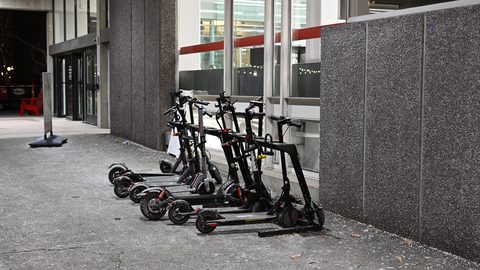 Electric Scooter Riding Skills: Techniques for Commuting, Braking and Hills
Learn fundamental electric scooter riding skills from first-ride stance to emergency braking, with step-by-step guides for rain, night, and hill riding.
Electric Scooter Riding Skills: Techniques for Commuting, Braking and Hills
Learn fundamental electric scooter riding skills from first-ride stance to emergency braking, with step-by-step guides for rain, night, and hill riding.
-
 Long Range Electric Scooters With Owner-Reported Distance at Real Rider Weight
Long-range electric scooters ranked by owner-reported distance at a real rider weight, not the manufacturer's 60 kg eco-mode claim, with battery capacity in watt-hours.
Long Range Electric Scooters With Owner-Reported Distance at Real Rider Weight
Long-range electric scooters ranked by owner-reported distance at a real rider weight, not the manufacturer's 60 kg eco-mode claim, with battery capacity in watt-hours.
-
 Best Electric Scooters for Adults: Commuter, Heavy Rider and Multi-Modal Picks
The best electric scooter for adults depends entirely on your commute: lightweight folders for train riders, durable tubeless models for daily abuse, and reinforced frames for heavier riders.
Best Electric Scooters for Adults: Commuter, Heavy Rider and Multi-Modal Picks
The best electric scooter for adults depends entirely on your commute: lightweight folders for train riders, durable tubeless models for daily abuse, and reinforced frames for heavier riders.
-
 Best Electric Scooter: The Models That Earn Their Spec Sheet in the Real World
The best electric scooter is the one whose real range, brake type, and stem durability match what the spec sheet promises. We compare the models that deliver.
Best Electric Scooter: The Models That Earn Their Spec Sheet in the Real World
The best electric scooter is the one whose real range, brake type, and stem durability match what the spec sheet promises. We compare the models that deliver.
-
 Best Electric Scooter Lights for Actually Seeing the Road at Night
Stock scooter lights are position markers, not headlights. The best electric scooter lights mount securely, survive rain, and project a beam you can actually ride by.
Best Electric Scooter Lights for Actually Seeing the Road at Night
Stock scooter lights are position markers, not headlights. The best electric scooter lights mount securely, survive rain, and project a beam you can actually ride by.