Bells and Electronic Horns for Electric Scooters: Legal Requirements and Real-World Effectiveness
Which bells and horns meet the legal audible-warning requirement for electric scooters and actually fit on a crowded handlebar without blocking the throttle.
The One Number That Governs Every Bell and Horn You Buy
An audible warning device on an electric scooter must produce at least 75 dB(A) measured at 7 metres under a stationary test. That is the minimum from UN Regulation No. 28, 04 series of amendments (2011). It is the baseline that most national laws reference directly or indirectly. Whether you need a mechanical bell or an electronic horn depends on your jurisdiction and your handlebar real estate. The floor is the same everywhere: 75 dB at 7 metres. The electric scooter bell horn legal requirement is not negotiable. The practical question is which device fits your specific scooter without interfering with the thumb control.
What the Law Says in Each Major Market
Germany: The Bell Mandate
Germany's StVZO §64a (2024) requires a bell on all bicycles and e-scooters under 11 kg. The bell must produce a single clear tone. No gongs. No ratchets. It must be operable without removing a hand from the grip. That last phrase is the one that causes trouble. The thumb control occupies the right grip, and many bells need a finger reach that conflicts with it.
France: Audibility at 50 Metres
France's Code de la route R313-33 (2019) mandates a bell or horn audible at 50 metres. That is a looser specification than the German one, with no tone restriction. The 50-metre audibility test effectively demands a louder device than the UN minimum. France classifies the device as a required safety item. Enforcement is rising.
The Netherlands and the UK
The Netherlands (Regeling voertuigen, artikel 5.9.51, 2020) requires a bell on all bicycles and e-scooters but sets no decibel minimum. The cheapest stamped-metal bell that rings qualifies. An electronic horn is also legal. The UK Department for Transport's 2020 e-scooter trials guidance requires a bell on rental scooters as a condition of trial approval. Private scooters remain illegal on public roads, so the question is moot for private owners until the law changes.
Decibel Output: Mechanical Bell vs Electronic Horn
An electric scooter electronic horn produces 80-120 dB(A) measured at 1 metre, according to manufacturer specifications from Xiaomi, Segway, and NIU. A mechanical bell (Knog, Crane, Spurcycle) produces 70-95 dB(A) at 1 metre. On paper, the electronic horn wins. In practice, the horn needs power, wiring, and a mounting spot that does not conflict with the thumb control or brake lever.
What 75 dB at 7 Metres Means in Real Riding
At 75 dB(A) and 7 metres, a pedestrian directly in front of you hears you clearly in a quiet street. In traffic noise, around 65-70 dB in a typical urban canyon, that same pedestrian may not register the sound until you are within 3 metres. A mechanical bell at its low end (70 dB) fails the UN test at 7 metres. A bell at 85 dB, which many models achieve when struck firmly, passes easily. The failure mode is not the bell's inherent output but the rider's reluctance to hit it hard enough. A striker with a stiff spring that demands a deliberate thumb press produces a louder ring than a feather-light lever. That is why the Spurcycle bell (brass dome, stainless striker) is the reference choice among commuters.
The dB Measurement Trap
Manufacturer dB figures are often quoted at 1 metre, not 7 metres. A horn rated at 100 dB at 1 metre loses roughly 12 dB of sound pressure level at 7 metres because sound attenuates by 6 dB per doubling of distance. That horn at 7 metres is around 88 dB, still well above the UN threshold. A bell rated at 80 dB at 1 metre delivers roughly 68 dB at 7 metres. It fails. Always check whether the quoted figure is at 1 metre or 7 metres before you buy.
| Device Type | Model Example | Quoted dB at 1 m | Estimated dB at 7 m | Passes UN 75 dB? |
|---|---|---|---|---|
| Mechanical bell | Spurcycle | 95 dB | 83 dB | Yes |
| Mechanical bell | Knog Oi | 75 dB | 63 dB | No |
| Mechanical bell | Crane E-NE | 85 dB | 73 dB | No |
| Electronic horn | Segway Ninebot integrated | 105 dB | 93 dB | Yes |
| Electronic horn | NIU KQi series | 100 dB | 88 dB | Yes |
| Electronic horn | Wolo (12V) | 110 dB | 98 dB | Yes |
Handlebar Compatibility: The Ninebot Max G30, Xiaomi M365, and Unagi Model One
The handlebar diameter standard for bell and horn clamps is 22.2 mm (ISO 6699:2016). Some scooters, particularly those with integrated displays or thumb-control housings, use 31.8 mm oversized bars. The Ninebot Max G30 uses a 22.2 mm bar. The Xiaomi M365 uses 22.2 mm. The Unagi Model One uses a proprietary 31.8 mm bar with minimal space between the thumb control and the grip.
Throttle Interference on the Ninebot Max G30 and Xiaomi M365
On the Ninebot Max G30, the thumb lever sits on the right side of the bar, adjacent to the grip. The space between the housing and the end of the grip is roughly 35 mm. A bell with a clamp narrower than 25 mm fits. The Spurcycle bell (clamp width 22 mm) fits without rubbing the lever. The Crane E-NE (clamp width 30 mm) demands that you reposition the thumb control by loosening its mounting screw. Possible, but it introduces a gap that feels unnatural. On the Xiaomi M365, the control is similarly placed, but the bar has a slight taper. Clamps that use a single screw-and-band design (Knog Oi) loosen on the taper within a few weeks. A double-bolt clamp (Spurcycle, Crane) holds better.
Unagi Model One Handlebar Constraints
The Unagi Model One Voyager and Classic use a 31.8 mm bar with an integrated display and thumb-control assembly that occupies almost the full right side. The remaining exposed bar is around 20 mm. No standard bell clamp fits that space without overhanging the control. The practical solution is an electronic horn mounted on the stem rather than the bar. The Unagi does not have a stock horn. An aftermarket 12V horn (Wolo or equivalent) can be wired to the power pack through a DC-DC converter. The converter adds mass and complexity. Most Unagi owners who need a legal audible device choose a bell that clips to the stem itself, the Knog Oi stem-mount variant. That device's output (75 dB at 1 m) fails the UN test at 7 metres, which means it may not meet France's 50-metre audibility requirement.
Electric Horn Installation: Power, Wiring, and Water Resistance
An electronic scooter horn operates at 12 V or 36 V DC. Most commuter-class scooters (Ninebot Max G30, Xiaomi Mi Pro 2, NIU KQi3 Max) have a 36 V power pack. A 12 V horn needs a DC-DC converter that steps the 36 V down to 12 V. A 36 V horn connects directly to the pack terminals or the controller's accessory output. The current draw of a typical horn is 0.5-3.0 A at nominal voltage. At 3 A continuous draw from a 36 V pack, a 10-second horn blast consumes 10.8 watt-hours, roughly 0.3% of a 360 Wh unit. Negligible for occasional use. Significant if the horn is wired to an always-on relay and drains through a parasitic load.
Wiring Connectors and Routing
The common connector type for scooter horns is a JST SM 2-pin or bare wire that needs soldering or crimping. The Segway Ninebot Max G30 has a stock horn connector inside the dashboard housing. Aftermarket horns with a JST SM 2-pin plug connect directly to that harness. The Xiaomi M365 has no stock horn connector. You must tap into the pack output or the controller's PCB. Cable routing from the bar-mounted activation switch down the stem to the compartment introduces a risk of pinching the wire during folding. Route the cable along the outside of the stem and secure it with zip ties. Replace the ties every time you fold the scooter. Vibration loosening of the cable ties is the reported failure mode.
Water Ingress and Corrosion
The minimum recommended ingress protection rating for an electronic horn is IP65 (IEC 60529, edition 2.2, 2013). IP65 means dust-tight and protected against low-pressure water jets. In practice, owner forums report that the diaphragm inside aftermarket horns corrodes within 3-6 months of regular riding in rain. The corrosion is caused by water entering through the horn's sound outlet, not through the housing. No horn on the market has a waterproof diaphragm. The only mitigation: mount the horn with the outlet facing downward so water drains instead of pooling on the diaphragm surface.
Mechanical Bell Selection and Maintenance
A mechanical bell for an electric scooter should be made of brass, aluminium alloy, or stainless steel (ISO 14878:2015 specifies a 24-hour neutral salt spray test for corrosion resistance). The striker spring is the component that fails first. Owner reports describe loss of ring tone after 6-12 months as the spring loses temper. The spring is replaceable on Spurcycle and Crane models. On the Knog Oi, the entire bell must be replaced. Mounting torque is 2-4 Nm for mechanical bells. Over-tightening cracks the bell dome or strips the clamp threads. Under-tightening causes the bell to rotate around the bar when you strike it, which misaligns the striker with your thumb.
Bell Placement and Throttle Clearance
The critical dimension for bar-mounted bell clearance is the clamp width. A bell with a clamp wider than 25 mm will interfere with the thumb control on a Ninebot Max G30 or Xiaomi M365. The Spurcycle bell (22 mm clamp) fits. The Crane E-NE (30 mm clamp) demands that you reposition the control housing. The Knog Oi (24 mm clamp) fits the M365 but loosens over time on the tapered bar. No bell on the market is designed specifically for scooter bar geometry. All are bicycle bells adapted to a tighter space. The failure case: you buy a bell, mount it, and find that your thumb cannot reach the striker without releasing the control. The only fix is to return the bell and buy a narrower one.
EN 17128 Standard and Its Real-World Effect
EN 17128 is the European standard for personal light electric vehicles, including e-scooters. It requires an audible warning device that meets the UN Regulation No. 28 threshold. The standard does not specify whether the device must be a bell or a horn. It specifies the output. A scooter that ships with an integrated electronic horn (Ninebot Max G30, NIU KQi3 series) satisfies EN 17128 at the factory. A scooter that ships without an audible device (Xiaomi M365, Unagi Model One) needs an aftermarket addition to meet the standard. In practice, German authorities enforce EN 17128 through StVZO §64a; French authorities through R313-33; Dutch authorities through the Regeling voertuigen. Enforcement is inconsistent. A police officer in Berlin measures the bell's audibility by ear, not with a decibel meter. A rider stopped without any audible device can expect a fine. In Germany, the scooter may be impounded until a compliant bell is fitted.
Who This Subject Suits and Who Should Skip It
This subject suits the urban commuter who rides a Ninebot Max G30 or Xiaomi M365 daily and needs a legal, practical bell that stays mounted. It suits the German rider who must comply with StVZO §64a and has exactly 35 mm of bar space to work with. It suits the French rider who needs a device audible at 50 metres and is willing to wire an electronic horn for the compliance certainty.
Skip this if you want the loudest possible horn for pedestrian intimidation. That belongs in a car-horn modification forum. Skip this if you own a Dualtron Thunder 3 or NAMI Burn-E 2, whose bar space is wider (31.8 mm) and whose stock setup already includes an electronic horn. Skip this if you expect to buy a discount bell and have it survive winter rain. The striker spring will corrode. The tone will fade. The bell will fail its audibility test within weeks. The single thing that most often goes wrong is not the wrong decibel rating. It is the rider who buys a bell that physically cannot fit between the thumb control and the grip, then rides legally exposed because they never mounted it.
Common Questions
Does my scooter need a bell or a horn to be legal in Germany?
StVZO §64a requires a bell that produces a single clear tone. No electronic horn. The bell must be operable without removing a hand from the grip. A Spurcycle bell on the right bar, mounted so your thumb can reach the striker while your fingers grip, satisfies the regulation.
What is the easiest way to add a bell to a Ninebot Max G30?
Buy a Spurcycle bell (22 mm clamp). Loosen the right grip slightly, slide the bell clamp between the thumb-control housing and the grip, and tighten to 2-4 Nm. The bell striker sits within thumb reach of your control hand. No wiring. No tools beyond a 4 mm hex key.
Will an electronic horn drain my scooter's power pack noticeably?
A 3 A horn used for 10 seconds draws 0.3% of a 360 Wh pack. That is negligible. The real drain is the DC-DC converter if you use a 12 V horn. A cheap converter draws 0.1-0.5 A even when the horn is silent. Disconnect the converter when not riding to avoid a flat pack after a week of storage.
Can I fit a bell on an Unagi Model One handlebar?
The 31.8 mm bar with integrated thumb control leaves roughly 20 mm of exposed bar. No standard bell clamp fits. Use a stem-mount bell such as the Knog Oi stem variant, or fit an aftermarket electronic horn wired to the pack with a DC-DC converter. The stem-mount bell likely fails the UN 75 dB at 7 m requirement.
Read next
-
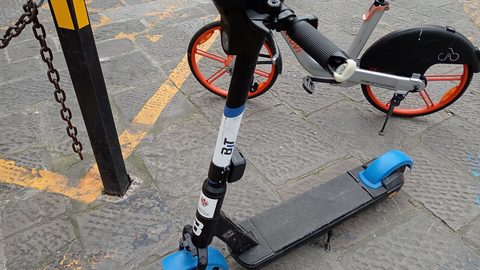 Electric Scooter Accessories: What to Buy and What Solves Which Problem
Which electric scooter accessories solve real problems: a guide to locks, phone mounts, lights and carrying solutions, with what to look for and any legal requirements.
Electric Scooter Accessories: What to Buy and What Solves Which Problem
Which electric scooter accessories solve real problems: a guide to locks, phone mounts, lights and carrying solutions, with what to look for and any legal requirements.
-
 Long Range Electric Scooters With Owner-Reported Distance at Real Rider Weight
Long-range electric scooters ranked by owner-reported distance at a real rider weight, not the manufacturer's 60 kg eco-mode claim, with battery capacity in watt-hours.
Long Range Electric Scooters With Owner-Reported Distance at Real Rider Weight
Long-range electric scooters ranked by owner-reported distance at a real rider weight, not the manufacturer's 60 kg eco-mode claim, with battery capacity in watt-hours.
-
 Best Electric Scooters for Adults: Commuter, Heavy Rider and Multi-Modal Picks
The best electric scooter for adults depends entirely on your commute: lightweight folders for train riders, durable tubeless models for daily abuse, and reinforced frames for heavier riders.
Best Electric Scooters for Adults: Commuter, Heavy Rider and Multi-Modal Picks
The best electric scooter for adults depends entirely on your commute: lightweight folders for train riders, durable tubeless models for daily abuse, and reinforced frames for heavier riders.
-
 Best Electric Scooter: The Models That Earn Their Spec Sheet in the Real World
The best electric scooter is the one whose real range, brake type, and stem durability match what the spec sheet promises. We compare the models that deliver.
Best Electric Scooter: The Models That Earn Their Spec Sheet in the Real World
The best electric scooter is the one whose real range, brake type, and stem durability match what the spec sheet promises. We compare the models that deliver.
-
 Best Electric Scooter Lights for Actually Seeing the Road at Night
Stock scooter lights are position markers, not headlights. The best electric scooter lights mount securely, survive rain, and project a beam you can actually ride by.
Best Electric Scooter Lights for Actually Seeing the Road at Night
Stock scooter lights are position markers, not headlights. The best electric scooter lights mount securely, survive rain, and project a beam you can actually ride by.