The Electric Scooter Buying Guide: What Specs Actually Matter
How to choose an electric scooter by the specs that matter: real range for your weight, brake types for wet stopping, and carry weight for daily use.
The Electric Scooter Buying Guide: What Specs Actually Matter
You finish a nine-hour shift, check the display, and see three bars. Home is 4 km away with a bridge that climbs at 6%. By the crest the bars are gone, the motor cuts, and you push 17 kg the last kilometre. That is when a claimed range figure becomes expensive knowledge. Read the spec sheet like a fleet buyer: as promises that shift under real weight, real speed and real weather.
Electric Scooter Buying Guide for Commuters: the Real Range Equation
The most deceptive number on any spec sheet is claimed range. Manufacturers test with a 60 kg rider on flat ground in eco mode at 15 km/h. A commuter weighs 80-85 kg, rides at 25 km/h, and faces hills and stop signs. Result: a scooter advertised at 45 km delivers 18-25 km for that rider. For a 70 kg rider on flat terrain, real range runs 60-80% of claimed. For a 90 kg rider on hills, it drops to 30-50%. Add cold between 0 and 5 °C and you lose another 15-25%.
Capacity is measured in watt-hours (Wh), not amp-hours. Watt-hours account for voltage. A 36 V pack advertised as 10 Ah is 360 Wh. That figure, paired with the motor's consumption rate, determines actual distance. A scooter drawing 500 W nominal drains a 360 Wh pack in roughly 40 minutes of continuous full throttle. The Ninebot Max G30 earns its reputation because its large pack and efficient sine-wave controller deliver a real 30-35 km for an 85 kg rider. That is as close to honest as the industry gets.
Why Top Speed Falls Off
Claimed top speed of 25 km/h is real only when the pack sits above 80% charge. Below that, voltage sag under load reduces speed progressively. You drift down to 22 km/h at 70% and 18 km/h at 40%. No firmware update fixes physics. The practical takeaway: if your commute requires sustained speed, budget for a pack at least 50% larger than the range calculator suggests.

Electric Scooter Brake Types Compared: What Stops You in the Wet
Your brakes are the single safety decision on a machine that hits 25 km/h with no crumple zone. Four types exist on consumer scooters. Each behaves differently when the road is wet.
Hydraulic Disc Brakes
Hydraulic disc brakes give the shortest stopping distance: 3.0-4.5 m from 25 km/h on dry asphalt with a 75 kg rider. They self-adjust as pads wear and need bleeding every few thousand kilometres. The downside is weight, cost and service complexity. Failure is gradual lever sponginess, not sudden cable snap.
Mechanical Disc Brakes
Mechanical disc brakes use a cable to pull the caliper. Stopping distance runs 3.0-4.5 m when adjusted correctly. The cable is the weak point: it frays internally at the folding joint and can snap without warning. Pad replacement is simple. Cable tension must be checked monthly. Rain reduces grip because the housing collects water and grit.
Drum Brakes
Drum brakes are enclosed and resist water and mud better than any disc. Stopping distance on dry asphalt is 4.0-6.0 m. They are nearly maintenance-free but harder to adjust when they wear. The tradeoff is weight and reduced modulation: an on/off feel rather than progressive squeeze.
Electronic and Foot Brakes
Electronic regenerative braking alone produces 6.0-10.0 m stopping distance. That is unsafe as a primary brake. It also fails when the pack is full because regenerative current has nowhere to go. Foot brakes pressing the rear mudguard give 5.0-8.0 m and are standard on rental scooters. They wear the mudguard mount and can snap it off entirely. The Xiaomi M365 rear mudguard fracture is the canonical example of this failure mode.
What Electric Scooter Weight Means for Daily Use
A scooter weighing 30 kg folds beautifully. You will not carry it up three flights of stairs more than twice. After the second week it stays in the lobby. After the third week it gets stolen. The weight spec decides whether a machine gets used daily or becomes an expensive doorstop.
Manufacturers understate weight by 5-10%: the claimed 15 kg machine reads 15.8-16.5 kg on a calibrated scale. The stem, handlebars and folding mechanism are excluded from published figures. For multi-modal commuting where you carry onto trains or into an office, look for scooters under 18 kg real weight. The E-TWOW GT and Unagi Model One sit in the 10-12 kg range. That weight saving comes from solid tyres and minimal shock absorption, which transmit every road vibration to the stem and accelerate solder joint fatigue in the electronics. The Vsett 8 at roughly 19 kg is a reasonable compromise: light enough to carry one-handed, heavy enough to include dampening that protects the components.
Electric Scooter Motor Power Guide: Watts and What They Actually Deliver
Motor wattage is the most inconsistently quoted spec in the industry. A motor labelled 500 W may be nominal continuous power, peak burst power, or a marketing number with no engineering basis. Two 500 W motors pulling together can peak at 1600 W combined for a few seconds. That climbs a 12% grade a single 500 W motor would struggle above. The real-world test is hill grade: if the spec claims a 20% grade, expect usable performance only up to 12% with an 85 kg rider. Grade figures are calculated from motor torque at the shaft, ignoring drivetrain losses and voltage sag.
For urban commuting on flat terrain, a single 500 W nominal motor is adequate. For hill climbs or heavier riders, dual motors are safer. The pack must match: a high-power motor on a small pack sags voltage instantly, making the motor feel weaker than a lower-power motor on a properly sized unit.
Tyres, Suspension and the Folding Mechanism: the Mechanical Truth
Three tyre types dominate. Pneumatic tyres give the best ride and grip but require weekly pressure checks; under-inflation causes pinch flats and cuts range. Tubeless tyres, like the Ninebot Max G30's self-sealing type, reduce puncture risk but demand a specific repair kit. Solid tyres eliminate punctures entirely. They also transmit every crack and stone to the stem, accelerating solder joint fatigue, stem clamp wear and bolt loosening over time. Honeycomb tyres sit between solid and pneumatic: they offer some compliance but de-bond from the hub under heat and shear stress, leaving you with no drive and reduced braking.
Suspension: Not Optional Past 1,000 km
Hydraulic suspension provides controlled damping but adds weight and requires bleeding. Rubber cartridge systems degrade silently and lose effectiveness over time. Spring suspension is simple but bounces. The Apollo City's dual setup is a solid middle ground for commuters who ride on mixed surfaces.
The Stem Folding Mechanism
This is the highest-consequence mechanical joint on the vehicle. Failure at speed is catastrophic. Collar clamp designs like the Xiaomi M365 require periodic tightening. Latch and pin lock designs like the Kaabo Mantis had documented stem snapping on early units from fatigue cracking in cast aluminium clamps. The Ninebot Max G30's locking mechanism is the most durable in the commuter class: a large-diameter pin and reinforced collar. Every scooter's stem develops play eventually. The fix is tightening or replacing the clamp. Do not ignore it.
IP Ratings: What Waterproof Actually Means
An IP rating is component-level, not scooter-level. A battery housing rated IPX5 means it withstands a water jet of 12.5 L/min at 30 kN/m² from a 6.3 mm nozzle for three minutes. That same rating on the housing does nothing for the throttle, display or controller. In sustained rain, the cockpit electronics fail first: the throttle sticks at full, the display delaminates, and the controller shorts out days later when corrosion bridges a trace. No consumer scooter is truly waterproof. IPX4 (splash resistant) is the realistic minimum for commuters who ride in drizzle. IPX5 on the battery housing is good. IPX6 or IPX7 on the whole vehicle is rare and often overstated.
How to Choose an Electric Scooter for Your Specific Use Case
The Urban Commuter: 3-8 km Each Way
Prioritise battery capacity above 400 Wh, pneumatic or tubeless tyres, a mechanical or hydraulic disc brake, and real weight under 20 kg. Buy the Ninebot Max G30 for longer real range and a proven fleet pedigree. Choose the Niu KQi3 for a wider deck and disc brakes. Pick the Vsett 8 if you want lighter and simpler.
The Multi-Modal Rider: Trains and Carry
Weight below 16 kg and a secure latch mechanism are decisive. The E-TWOW GT and Glion Dolly are the lightest options. The Glion's solid honeycomb tyres and lack of suspension make it punishing on anything but smooth tarmac. The Unagi Model One looks beautiful but rides harder than any other scooter at its price. Get the E-TWOW GT if you must stay ultralight; its mechanical suspension actually works.
Parents Buying for a Teenager
Prioritise build quality and local legality. Most scooters ship locked to 25 km/h. Software or hardware unlocks void the warranty and legal compliance. Skip the Razor E Prime; it is what a non-researching parent buys because they recognise the brand. Buy the Xiaomi M365 or 1S for the same money, with a far larger parts ecosystem and better brakes. Check local age and helmet requirements before looking at colours.
Fleet Operators Evaluating Bulk Purchases
Duty cycle data and parts availability matter more than consumer features. The Ninebot Max G30 has a large battery, self-sealing tubeless tyres, and a parts ecosystem that includes replacement motors, controllers and brake calipers available globally. The Okai Neon is the OEM behind many rental fleets but has weaker parts support outside China. Avoid any model with proprietary brake pads, tyres or inner tubes: standard parts determine repairability.
Who Should Skip Electric Scooters Entirely
Skip scooters if you need an e-bike, e-moped or electric motorcycle; those have different regulation and failure modes. Skip them if you are seeking a mobility aid for a disability; these are recreational and commuter vehicles with no medical device certification. Skip them if you expect a weatherproof car replacement; scooters are fair-weather vehicles with no crash protection. And skip anything priced below the band where hydraulic brakes and pneumatic tyres appear. Below that band the machines are functionally disposable.
Common Questions
How much real range should I expect from a scooter advertised at 45 km?
Expect 18-25 km for an 85 kg rider at 25 km/h in moderate temperatures. Half the claimed figure is the conservative estimate. Add hills or cold weather and you lose more.
Can I rely on electronic regenerative braking as my only brake?
No. Electronic braking alone gives 6-10 m stopping distance from 25 km/h, and fails when the battery is full. Every scooter needs a mechanical brake as primary.
What IP rating is enough for riding in rain?
IPX4 is the realistic minimum for drizzle. IPX5 on the battery housing is good, but the throttle and display will still fail in sustained rain regardless of claims.
How often should I check the folding mechanism?
Check the clamp tightness before every ride. Stem play develops gradually and failure at speed is catastrophic. Tighten or replace the clamp at the first sign of looseness.
Read next
-
 Electric Scooter Safety: NTA-8776 Helmets, Braking Distance and Visibility
Electric scooter safety starts with the NTA-8776 helmet standard, understanding real braking distances, and knowing the mechanical failure modes that matter at speed.
Electric Scooter Safety: NTA-8776 Helmets, Braking Distance and Visibility
Electric scooter safety starts with the NTA-8776 helmet standard, understanding real braking distances, and knowing the mechanical failure modes that matter at speed.
-
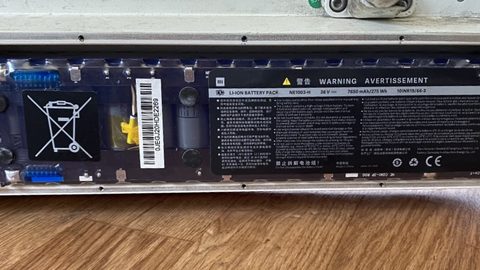 Electric Scooter Batteries: Wh Capacity, 21700 Cells and Real Cycle Life
Electric scooter batteries explained: why watt-hours is the honest capacity unit, how 21700 cells differ from 18650, and what actually shortens pack life.
Electric Scooter Batteries: Wh Capacity, 21700 Cells and Real Cycle Life
Electric scooter batteries explained: why watt-hours is the honest capacity unit, how 21700 cells differ from 18650, and what actually shortens pack life.
-
 Electric Scooter Commuting: Carry Weight, Folded Size and Wet Weather Reality
What electric scooter commuting actually demands: real carry weight for stairs, folded dimensions for trains, wet weather survival and charging logistics.
Electric Scooter Commuting: Carry Weight, Folded Size and Wet Weather Reality
What electric scooter commuting actually demands: real carry weight for stairs, folded dimensions for trains, wet weather survival and charging logistics.
-
 Electric Scooter Maintenance: Stem Bolts, Brake Pads and Tyre Pressure Intervals
Electric scooter maintenance schedule covering stem bolt torque checks, brake pad intervals, tyre pressure and the folding mechanism service that prevents failure.
Electric Scooter Maintenance: Stem Bolts, Brake Pads and Tyre Pressure Intervals
Electric scooter maintenance schedule covering stem bolt torque checks, brake pad intervals, tyre pressure and the folding mechanism service that prevents failure.
-
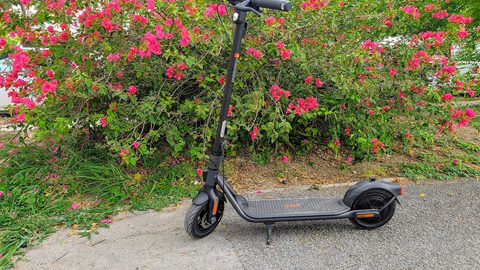 Segway Ninebot ES3
The Ninebot Segway ES3 was discontinued in 2021 but is still traded heavily used, and it remains a genuine argument as a first electric scooter.
Segway Ninebot ES3
The Ninebot Segway ES3 was discontinued in 2021 but is still traded heavily used, and it remains a genuine argument as a first electric scooter.
-
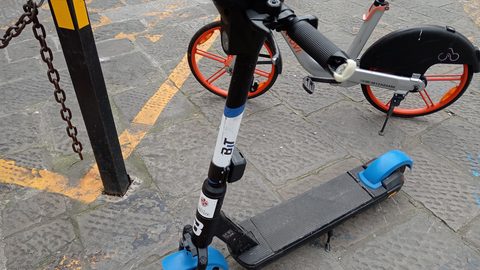 Fluid FreeRide CityRider
The Fluid Freeride CityRider is the mid-band commuter this catalogue keeps pointing people at when they arrive looking at something twice the weight.
Fluid FreeRide CityRider
The Fluid Freeride CityRider is the mid-band commuter this catalogue keeps pointing people at when they arrive looking at something twice the weight.
-
 Weped FS
The Weped FS weighs 45 kg and has real hydraulic suspension, and that weight is the organising fact of ownership no spec sheet can soften.
Weped FS
The Weped FS weighs 45 kg and has real hydraulic suspension, and that weight is the organising fact of ownership no spec sheet can soften.
-
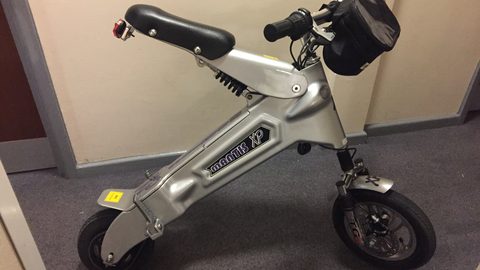 Rion RE90
The Rion RE90 is the lightest genuinely fast electric scooter, built in small numbers with almost no weather sealing and a six-month warranty.
Rion RE90
The Rion RE90 is the lightest genuinely fast electric scooter, built in small numbers with almost no weather sealing and a six-month warranty.
-
 Mercane MX60
The Mercane MX60 is a 41 kg dual-motor scooter whose real story is the gap between what it can do and what an owner will do with it daily.
Mercane MX60
The Mercane MX60 is a 41 kg dual-motor scooter whose real story is the gap between what it can do and what an owner will do with it daily.