The Best Folding Electric Scooters for Commuters Who Carry Them
Folding electric scooters ranked by real carry weight, folded dimensions and fold time, for commuters who lift their scooter onto a train or up stairs every day.
Affiliate links. If you buy through the links below we may earn a commission, at no extra cost to you. How this works.
The Best Foldable Electric Scooters Are Defined by Carry Weight, Not Range
For a commuter carrying a scooter onto a train or up stairs daily, the single decisive specification is carry weight. The best foldable electric scooters in this category are ranked first on that number and on folded size. A machine that folds but weighs 30 kg is not portable. One that folds but still occupies a full suitcase footprint does not solve the problem. Manufacturers publish claimed range and top speed prominently. They obscure fold time, latch durability, and real weight. This ranking is built on what actually matters for the rider who folds twice daily.
What Makes a Scooter Portable Enough for Daily Carry
The difference between a scooter that folds for occasional garage storage and one that folds for a train commute is the time the fold takes and the number of hands required. A two-handed fold that takes 15 seconds and requires you to bend to the ground is tolerable once a week. Doing it twice daily, in a train doorway or a wet station forecourt, makes it the wrong machine. Manufacturers never publish fold time. The aggregate reports are consistent: the fastest folds use a single lever at the stem base that releases the latch in one motion and a hook that catches the stem to the rear fender without alignment fiddling. The slowest folds involve a collar clamp that must be loosened, a safety pin that must be pulled, and a secondary latch at the deck that requires a separate bend.

The Ranking Criteria: Carry Weight, Folded Dimensions, and Latch Durability
Every scooter on this list is evaluated first on kerb weight and folded size. A 13 kg machine that folds to the size of a small cabin bag is genuinely carryable. A 17.5 kg unit that folds to a larger footprint is borderline but workable for a strong adult on a short stair climb. Anything above 20 kg is a wheeled vehicle that you roll, not carry, and belongs in a different comparison.
Folding Mechanism And Stem Security
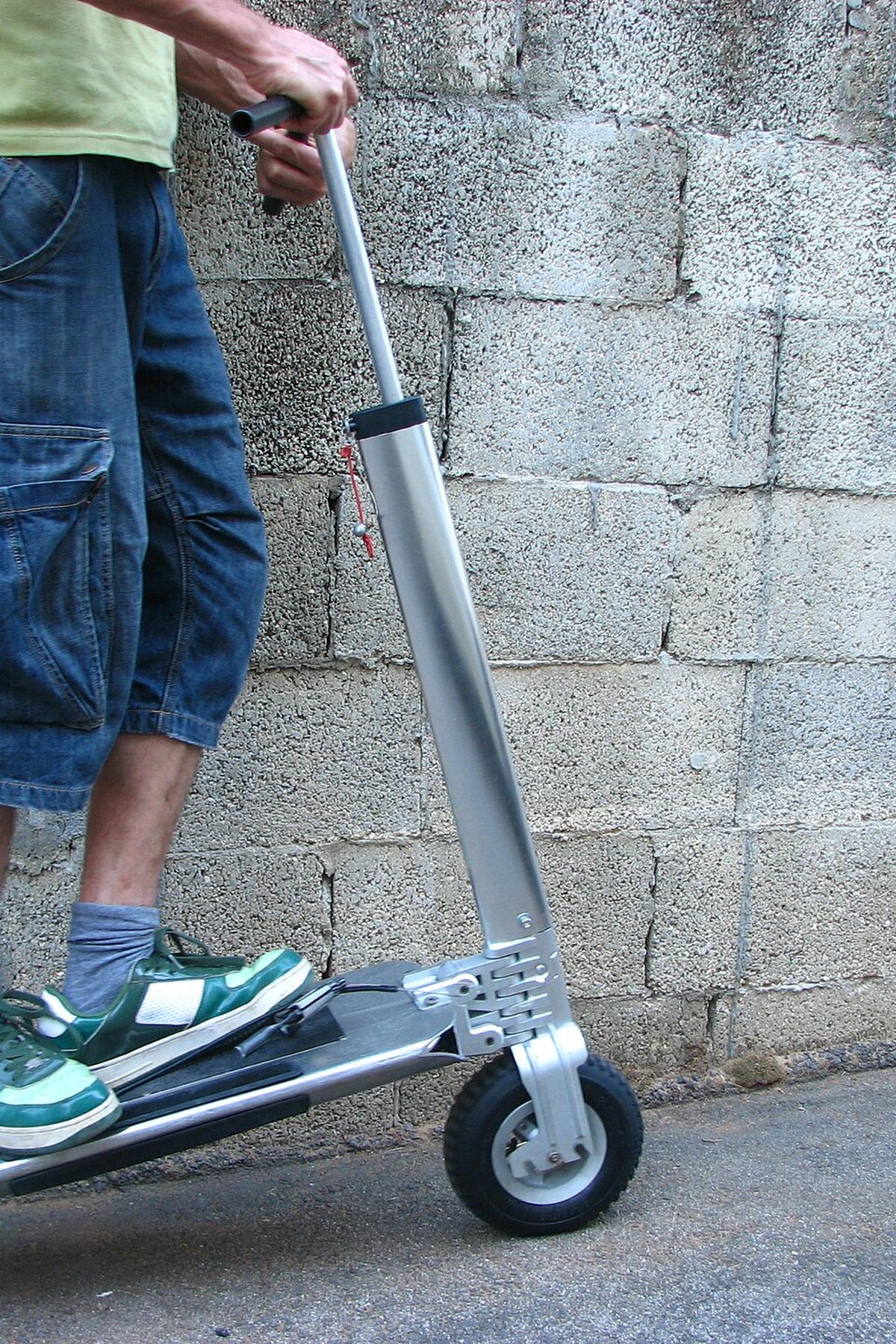
The second criterion is the folding mechanism itself. A latch that survives thousands of cycles without developing play is the difference between a scooter that still feels tight after a year and one that develops stem wobble at the hinge. At 25 km/h that is a safety issue. The third criterion, folded dimensions, determines whether the unit fits under a train seat, in a standard office locker, or beside a desk without blocking an aisle. The table below orders the contenders by carry weight, with the lightest first, and notes the folded size, fold mechanism type, and documented latch failure patterns.
Lightweight Folding Electric Scooter: the Ultralight Class Under 13 Kg
If you search for a lightweight folding electric scooter, the floor is around 12.5 kg. The E-TWOW GT Sport holds that floor at 12.5 kg with folded dimensions of 93 by 13 by 36 cm. That is narrow enough to slide beside a briefcase. Its single-lever clamp at the stem base folds the stem parallel to the deck, and the handlebars fold inward via a separate quick-release. That separate handlebar fold adds time to the process. Owner reports document cracking at the plastic lever pivot of the handlebar quick-release clamp. The trade-off is that the E-TWOW uses solid tyres and a proprietary mechanical suspension that transmits every road imperfection to the stem and electronics, accelerating solder-joint fatigue. The ride is harsh.
Glion Dolly And Unagi: Two Approaches To Portability
The Glion Dolly Foldable comes in at 12.7 kg with folded dimensions of 96.5 by 30.5 by 20.3 cm, and it has a unique advantage: integrated dolly wheels that let you roll it upright like a suitcase. The fold is a two-step process, stem lever to deck, then deck midpoint hinge with a secondary latch. The deck midpoint hinge has been reported to develop play after roughly 500 fold cycles. The Unagi Model One Voyager, at 13.6 kg with folded dimensions of 96.5 by 40.6 by 38.1 cm, uses a single-click aluminium hinge at the base of the stem that hooks onto the rear fender. Its stem wobble at the hinge after 6 to 12 months of daily use is the most documented fold-latch failure in this weight class.
Portable Electric Scooter for Train: the Sub-18 Kg Class
For a portable electric scooter for train use, the practical upper limit is roughly 17.5 kg. Several of the most durable commuters sit at exactly that weight. The Segway Ninebot Max G30LP weighs 17.5 kg with folded dimensions of 110.5 by 47.2 by 53.3 cm. Its lever-actuated steel collar at the stem base latches onto a rear fender hook. The collar loosening requires periodic bolt tightening, and the fender hook itself has been reported to break in cold weather. The Segway Ninebot F2 Pro also weighs 17.5 kg with folded dimensions of 114 by 48 by 50 cm, adds a safety pin at the stem base, and the safety pin retention spring has been reported weakening after prolonged wet exposure.
Apollo Air And Xiaomi: Lighter Alternatives
The Apollo Air 2024, also 17.5 kg with folded dimensions of 109 by 43 by 48 cm, uses a triple-locking system: a side-release lever, a safety collar, and a stem-to-deck latch. Its documented failure is the side-release lever pivot bolt backing out without threadlocker reapplication. The Xiaomi Mi Electric Scooter 3 weighs 13.2 kg, lighter than these, with folded dimensions of 108 by 43 by 49 cm. Its single-lever quick-release with bell-clamp to the rear mudguard is fast. The bell-clamp loosens over time, and the mudguard hook suffered fracture on early production runs from 2019 to 2020.
Electric Scooter Folded Dimensions: What Fits Where
A scooter that is too long to fit under a train seat or too wide to roll through a ticket gate is not portable, regardless of weight. The E-TWOW GT Sport at 93 by 13 by 36 cm is the smallest in all three dimensions. The Glion Dolly Foldable at 96.5 by 30.5 by 20.3 cm is the best for vertical storage because its dolly wheels allow upright rolling. The Unagi Model One Voyager at 96.5 by 40.6 by 38.1 cm is short but wide and tall, making it awkward in narrow train aisles. The Xiaomi Mi Electric Scooter 3 at 108 by 43 by 49 cm and the Apollo Air 2024 at 109 by 43 by 48 cm are both compact enough for a standard office locker but too long to fit under most train seats lengthwise. The Segway Ninebot G30LP at 110.5 by 47.2 by 53.3 cm and the Segway Ninebot F2 Pro at 114 by 48 by 50 cm are the largest in this comparison. They will not fit under a train seat at all. Stand them upright in a luggage area or hold them between your legs.
Compact Electric Scooter Carry Weight: the Trade-Offs at Every Kilo
Every kilogram saved costs either structural stiffness or ride quality. The E-TWOW GT Sport at 12.5 kg uses solid tyres and a minimal frame, which saves weight but transmits every road imperfection to the rider and the electronics. The Glion Dolly at 12.7 kg uses honeycomb solid tyres with no suspension. That is tolerable on smooth pavement but punishing on cracked city streets. The Unagi Model One Voyager at 13.6 kg uses solid tyres and dual motors, and its ride is among the harshest of any scooter at any weight.
What Heavier Machines Buy You
At 17.5 kg, the Segway Ninebot Max G30LP and Apollo Air 2024 use pneumatic tyres and mechanical suspension. This provides a smoother ride and better grip in wet conditions. At 20.3 kg, the Niu KQi3 Pro uses tubeless pneumatic tyres and a wider deck for stance stability. Its weight buys structural stiffness and a longer duty cycle. The trade-off is that a 20.3 kg scooter is not carried up stairs daily by most adults. The Xiaomi Mi Electric Scooter 4 Ultra at 24.5 kg and folded dimensions of 119 by 55 by 53 cm is heavier and larger than every other model here. Its dual-lever locking collar and deck-mounted latch are robust, but it is a wheeled vehicle that you roll, not carry. Consider it a non-portable machine.
Fold Time and Latch Security: the Difference Between a Commuter and a Garage Toy
Aggregate owner reports indicate that the fastest folds in this group belong to the E-TWOW GT Sport and the Xiaomi Mi Electric Scooter 3. Each takes roughly 5 to 8 seconds from ride-ready to folded with one hand on the stem lever. The E-TWOW requires a separate handlebar fold that adds another 5 seconds. The Glion Dolly takes 10 to 12 seconds because of its two-step process. The Segway Ninebot Max G30LP takes 8 to 10 seconds with its lever-actuated steel collar, but the collar loosening issue means riders must check bolt tightness weekly. The Apollo Air 2024 takes 10 to 12 seconds because of its triple-locking system, and the pivot bolt backing out requires periodic threadlocker reapplication. The Niu KQi3 Pro takes roughly 10 seconds with its single-lever joint and secondary safety ring. The safety ring seizing after winter salt exposure has been reported. The Dualtron Mini at 22.0 kg takes 15 to 20 seconds because its dual-lever locking collar must be loosened and retightened. Owner reports document that the collar bolts require re-torquing every 200 km to prevent stem play. The Kaabo Mantis 8 at 22.5 kg takes a similar time, and its locking pin bending under high-force loads on 2022 models was resolved in a 2023 revision.
When A Latch Fails
The distinction between a scooter that folds for occasional storage and one that folds twice daily is the latch that survives thousands of cycles without developing play. The Unagi Model One Voyager stem wobble at the hinge after 6 to 12 months of daily use, the Glion Dolly deck midpoint hinge play after 500 cycles, and the Hiboy S2 Pro rear fender latch bolt shearing under repeated impact are all mechanisms that are adequate for occasional use but unreliable for daily commuter duty.
Who Should Skip This Category Entirely
If folded size does not matter to you, if you never carry a scooter up stairs or onto a train, then a non-folding or heavier scooter will almost always ride better for the same money. Weight buys structural stiffness. That reduces flex in the deck and stem under cornering and braking. Weight also buys suspension quality: hydraulic dampers, pneumatic tyres with thicker sidewalls, and stronger brake calipers. A scooter that weighs 22 to 25 kg but does not fold, or folds into a shape too large to carry, will outperform any 12.5 kg machine on pothole absorption, braking distance on wet asphalt, and hill climbing at near-maximum load. The Dualtron Mini, Kaabo Mantis 8, and Inokim Quick 4 are all models that fold but are heavy enough that their portability is marginal. They belong in a performance comparison, not a portable commuter comparison. The Xiaomi Mi Electric Scooter 4 Ultra at 24.5 kg is in the same position: it folds but is too heavy to carry daily, so it is a wheeled garage vehicle that happens to have a folding joint.
The One Specification That Determines Real-World Range
Published range figures assume a 60 kg rider on flat ground in eco mode at 15 km/h. Real range for an 85 kg rider at 25 km/h in moderate temperatures is half the claimed number. A scooter with a claimed 45 km range will deliver 18 to 25 km in real use. Battery capacity in watt-hours is the only specification that correlates with real range. A 10 percent degradation in the first year is normal for cells without thermal management. The Segway Ninebot Max G30LP delivers a real range of roughly 18 to 22 km for an 85 kg rider. The Xiaomi Mi Electric Scooter 3 delivers roughly 12 to 16 km. The E-TWOW GT Sport delivers roughly 10 to 14 km. If your commute is 8 km each way, the Segway Ninebot Max G30LP will make the round trip with margin. The Xiaomi Mi Electric Scooter 3 will require a charge at the office. The E-TWOW GT Sport will not make the round trip on a single charge in cold weather or with hills. Charge time is another overlooked specification: the claimed 4 hours is 5 to 6 hours for a full 0 to 100 percent cycle because the final constant-voltage phase is slower than the constant-current bulk charge.
What Determines Whether a Scooter Survives 12 Months of Daily Folding
The folding mechanism on any scooter is a cast aluminium or steel clamp that receives repeated stress from the rider's body weight transferred through the stem during acceleration, braking, and cornering. A well-designed mechanism uses a latch or pin-lock that distributes the load across a broad surface, not a single-point collar clamp that concentrates stress. The Segway Ninebot Max G30LP's lever-actuated steel collar is the most common design in the mid-weight class. Its documented loosening requires periodic bolt tightening because the collar is a single-point clamp. The Apollo Air 2024 triple-locking system distributes load across three points, but the side-release lever pivot bolt backing out without threadlocker reapplication shows that more components mean more failure points. The Glion Dolly Foldable deck midpoint hinge developing play after 500 cycles is a design that uses a hinge pin in a plastic or light alloy bushing that wears under repeated folding. The E-TWOW GT Sport handlebar quick-release clamp cracking at the plastic lever pivot is a material choice that favours weight saving over durability. The Xiaomi Mi Electric Scooter 3 bell-clamp loosening and mudguard hook fracture are the canonical example of a design that works well for occasional folding but fatigues under daily use. A latch that still feels tight after a year of twice-daily folding is the benchmark for a truly portable commuter.
Tyre Type, Suspension, and the Ride Quality Trade-Off
Solid tyres eliminate punctures but transmit every road vibration to the stem, deck, and electronics. That accelerates solder-joint fatigue and stem-clamp wear. The E-TWOW GT Sport, Unagi Model One Voyager, and Glion Dolly Foldable all use solid or honeycomb tyres. The E-TWOW has a proprietary mechanical suspension that absorbs some vibration, but owner reports indicate that the suspension degrades over time and the ride remains harsh compared to any model with pneumatic tyres. The Unagi Model One has no suspension at all. Its ride is punishing on anything but smooth tarmac. The Glion Dolly uses honeycomb solid tyres with no suspension, and its ride is tolerable only on smooth pavement. Pneumatic and tubeless tyres, as used on the Segway Ninebot Max G30LP and the Niu KQi3 Pro, provide better grip and ride comfort but require pressure checks. Under-inflation causes pinch flats that increase rolling resistance and cut range. The Apollo Air 2024 uses pneumatic tyres with mechanical disc brakes. Its stopping distance on dry asphalt with an 85 kg rider is roughly 6 to 8 metres, not the 4 metres manufacturers claim.
Why Voltage Sag and Battery Management Matter More Than Published Range
Voltage sag is the drop in voltage when the motor draws high current. A scooter at 40 percent indicated battery may not achieve its top speed or climb its rated grade because voltage sag under load reduces speed progressively, not suddenly. The published top speed of 25 km/h becomes 22 to 24 km/h when the battery is below 80 percent charge. The battery management system protects cells from over-discharge and over-charge, but a BMS failure can brick the pack or, in rare cases, cause a thermal runaway. Do not charge unattended. The Segway Ninebot Max G30LP uses a self-sealing tubeless tyre system that reduces puncture risk, and its BMS is one of the most field-tested in the industry because the G30 platform is used in rental fleets worldwide. The Xiaomi Mi Electric Scooter 3 uses a simpler BMS that does not balance cells as aggressively. Its battery degrades faster for riders who fast-charge or store it fully charged. The E-TWOW GT Sport battery uses Chinese domestic cells that have a shorter cycle life than the LG or Samsung cells found in higher-priced models. The claimed 500 cycles to 80 percent capacity is more likely 300 to 400 cycles for scooters routinely fast-charged or stored fully charged.
Which Scooters Were Excluded and Why
The Xiaomi Mi Electric Scooter 4 Ultra at 24.5 kg was excluded from the portable class because it is heavier and larger than every other model in this comparison. It folds but is a wheeled vehicle that you roll, not carry. The Dualtron Mini at 22.0 kg and the Kaabo Mantis 8 at 22.5 kg were excluded because their carry weight places them in a performance category, not a portable commuter category. Their folding mechanisms are secondary to their power output. The Inokim Quick 4 at 21.5 kg was excluded for the same reason: its weight is at the upper limit of portability for a strong adult, and its double-lock pin spring corrosion in coastal climates adds a failure mode that does not affect lighter models with simpler mechanisms. The Niu KQi3 Pro at 20.3 kg was included in the discussion but not recommended for daily stair climbing. Its weight is at the threshold where most adults will choose to roll rather than carry. The Xiaomi Mi Electric Scooter 3 at 13.2 kg is the lightest option with pneumatic tyres and a proven parts ecosystem, making it the best recommendation for a rider who wants a smooth ride and easy repairability at the cost of a bulkier folded shape and a bell-clamp that loosens over time.
The Honest Caveat
Every folding electric scooter will develop play in its stem joint eventually. The difference between a scooter that is still rideable after 12 months of daily folding and one that is not is the design of the latch, the quality of the materials, and the rider's willingness to check bolt torque regularly. No manufacturer publishes durability test data for the folding joint in kilometres or folding cycles. The information here comes from aggregating owner reports across forums. Those reports are anecdotes without standardised measurement. A scooter that one owner reports as tight after 2000 km may be reported as wobbly by another owner at 500 km if the second rider is heavier or rides on rougher roads. The best portable scooter for you is the one that fits your weight, your commute distance, your local climate, and your tolerance for maintenance. If you weigh more than 90 kg, a scooter at the lower end of the weight range will flex more under load and accelerate stem joint wear. If your commute includes sustained hills, the voltage sag of a small battery will frustrate you regardless of how light the machine is. If you live in a coastal or salted-winter climate, the corrosion of pins and springs documented on the Apollo Air 2024 and the Niu KQi3 Pro will be a factor regardless of how carefully you fold.
Common Questions
What is the lightest folding electric scooter that is actually durable enough for daily commute?
The E-TWOW GT Sport at 12.5 kg is the lightest scooter that has a documented owner base reporting daily use over multiple years. Its trade-off is solid tyres and a harsh ride that accelerates stem-clamp wear and electronics vibration fatigue. The Glion Dolly Foldable at 12.7 kg is nearly as light and adds the advantage of dolly wheels for rolling upright, but its deck midpoint hinge develops play after roughly 500 fold cycles.
How do folded dimensions affect whether a scooter fits on a train?
A scooter with folded length under 100 cm and folded width under 30 cm, such as the E-TWOW GT Sport at 93 by 13 by 36 cm or the Glion Dolly at 96.5 by 30.5 by 20.3 cm, will fit under most train seats and in standard luggage racks. Models with folded length over 110 cm, such as the Segway Ninebot Max G30LP at 110.5 by 47.2 by 53.3 cm, require upright storage in a luggage area.
What is the most common failure point on folding electric scooters?
The folding mechanism itself is the highest-stress mechanical joint and the most common failure point. Every scooter's stem will develop play eventually. The fix is tightening or replacing the clamp, but on some models such as the Unagi Model One Voyager, stem wobble at the hinge is reported after 6 to 12 months of daily use and may require hinge replacement rather than tightening.
Can I ride a folding electric scooter in the rain?
IP ratings on electric scooters cover the battery housing only, not the cockpit electronics, throttle, or display. An IPX5 rating means the battery housing is protected against jets of water, but the throttle and display fail in sustained rain. Water ingress kills controllers and battery management systems, and the failure may not appear until days after exposure when corrosion bridges a trace. No scooter is truly waterproof regardless of claims.
Which folding electric scooter has the fastest fold mechanism?
The E-TWOW GT Sport and the Xiaomi Mi Electric Scooter 3 each fold in roughly 5 to 8 seconds from ride-ready using a single-lever clamp at the stem base. The E-TWOW requires an additional 5 seconds for handlebar folding. The Glion Dolly Foldable takes 10 to 12 seconds because of its two-step process. The Segway Ninebot Max G30LP takes 8 to 10 seconds but requires periodic bolt tightening to maintain latch security.
Read next
-
 Long Range Electric Scooters With Owner-Reported Distance at Real Rider Weight
Long-range electric scooters ranked by owner-reported distance at a real rider weight, not the manufacturer's 60 kg eco-mode claim, with battery capacity in watt-hours.
Long Range Electric Scooters With Owner-Reported Distance at Real Rider Weight
Long-range electric scooters ranked by owner-reported distance at a real rider weight, not the manufacturer's 60 kg eco-mode claim, with battery capacity in watt-hours.
-
 Best Electric Scooters for Adults: Commuter, Heavy Rider and Multi-Modal Picks
The best electric scooter for adults depends entirely on your commute: lightweight folders for train riders, durable tubeless models for daily abuse, and reinforced frames for heavier riders.
Best Electric Scooters for Adults: Commuter, Heavy Rider and Multi-Modal Picks
The best electric scooter for adults depends entirely on your commute: lightweight folders for train riders, durable tubeless models for daily abuse, and reinforced frames for heavier riders.
-
 Best Electric Scooter: The Models That Earn Their Spec Sheet in the Real World
The best electric scooter is the one whose real range, brake type, and stem durability match what the spec sheet promises. We compare the models that deliver.
Best Electric Scooter: The Models That Earn Their Spec Sheet in the Real World
The best electric scooter is the one whose real range, brake type, and stem durability match what the spec sheet promises. We compare the models that deliver.
-
 Best Electric Scooter Lights for Actually Seeing the Road at Night
Stock scooter lights are position markers, not headlights. The best electric scooter lights mount securely, survive rain, and project a beam you can actually ride by.
Best Electric Scooter Lights for Actually Seeing the Road at Night
Stock scooter lights are position markers, not headlights. The best electric scooter lights mount securely, survive rain, and project a beam you can actually ride by.